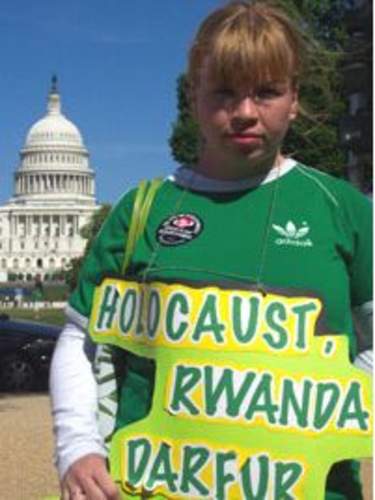
By Sheryl Nance-Nash
"College students are on the front line of the Darfur advocacy effort. They are taking a leading role," says Allyn Brooks LaSure, a spokesperson for the Save Darfur Coalition.
Students at Norfolk State University fight for Darfur.
They are lifting their voices in the outcry over the atrocities in Darfur. More than 400,000 people have been killed by Sudanese government forces and armed militia over the last five years. An estimated 2.5 million people have been displaced.
The Darfur genocide did not begin overnight. It was born out of a history and tradition of brutality in which former National Islamic Front (NIF) regime – now the National Congress Party (NCP) – of the Government of Sudan, based in Khartoum, has systematically destroyed different populations. The crisis in Darfur first began when rebels who are mostly ethnic African farmers attacked government outposts in 2002 because they wanted power. The Sudanese government repressed the insurgency, bombing villages and arming Arab herdsmen, Janjaweed, who have a history of land disputes with the farmers.
In 2004 the U.S. government declared the atrocities in Darfur genocide. Congress has passed and President Bush signed, several important pieces of legislation intended to "ease the people's suffering and inhibit the perpetrators in Khartoum," says Sean Redding, spokesperson for STAND, a student anti-genocide coalition based in Washington, D.C. Formed in 2004, it now has more than 1,000 chapters across the globe, primarily in the U.S.
President Bush has a special envoy to Sudan, who works to address many issues including genocide. But, says Redding, the U.S. could be doing a great deal more. This spring STAND launched a campaign targeting the executive branch with a specific list of policy demands for the Bush administration. The broad policy outline was "stick to your promises, enable UNAMID, apply an all-Sudan solution, and lobby China," says Redding.
With those broader demands comes a variety of specific needs. Redding explains, "The U.S. could do a much better job financially supporting the Joint African Union-United peacekeeping forces currently on the ground in Darfur (UNAMID); as of now, says Redding, the force is understaffed and needs more equipment. "The Administration and the State Department could use more diplomatic clout to pressure African countries in Sudan's region to better support the force as well. The U.S. can do more to pressure the Chinese government to put its influence over the Government of Sudan to good use. With the Olympics coming up, there is even more of an opportunity for the U.S.," he adds.
Voices on historically black colleges and universities have not remained silent over the last few years. Spelman hosted a Darfur Awareness Week to raise consciousness and funds, as well as to advocate for political action. In 2007 Howard University became the first HBCU to pass a resolution divesting from Sudan and any company doing business in the African nation. Others such as Hampton University have divested. Tuskegee University students teamed with the student NAACP organization to hold educational forums. In addition, they have held a candlelight vigil and raised money for the people of Darfur.
Members of the Black Congressional Congress are doing their part to shine the spotlight on Darfur. Congresswoman Barbara Lee (CA-9) has been to Darfur, Chad, Sudan and IDP camps three times. "I've seen and heard and felt the devastation from survivors of the genocide," she said at a recent press conference. "With tensions between rebel groups in Darfur rising, deteriorating relations between Chad and Sudan, and the continued obstruction of peacekeeping troops by the regime in Khartoum, we need bold action now to change the dynamic on the ground and bring an end to the violence," she said. She has been pushing for additional emergency spending for peacekeeping operations in Sudan and pushing for continued divestment from companies supporting the government of Sudan. She said more than 61 universities, 24 states and 19 cities have chosen to divest from companies doing business in Sudan. Last year the President signed legislation designed to enable and protect the nationwide divestment movement, while also banning new federal contracts with offending companies.
"The people of Darfur are counting on us for help. The longer we wait to act, the longer we are stymied in our efforts, the worse the situation will get," she added.
MAINTAINING MOMENTUM
Now is not the time to let momentum die. "The Government of Sudan returned to a scorched earth policy of village and IDF camp burning in February, and this appears to be continuing. Aid workers are being attacked more than ever before, and a food crisis is looming – many Darfuris are on the brink of starvation now as the camps run out of supplies," says Redding.
The horrors are not too distant to touch college campuses in the U.S. "When you see the graphically violent drawings of traumatized children in refugee camps and hear the stories of family members being burned or shot in their own villages, you can't easily forget it and just look away. The stories of the women and children are the most difficult to hear, they are unimaginable in our own lives," says Katrina Field, who started the STAND chapter at Norfolk State University in Virginia, in 2005. The history major has met with members of Congress and attended conferences. Her chapter has held fundraisers and film screenings. She also participated in STAND protests, including the Rally for Darfur in Washington, D.C. in April 2006 which had more than 15,000 attendees.
Jon Sena, says it's his, and others' duty as good ‘world' Samaritans, to be aware of our surroundings and to use our numbers to influence our leaders to discourage the mass killings, the violations of human rights." Sena, a senior at the University of the District of Columbia is a political science major and describes himself as very politically active, having interned with the House of Representatives and the Senate, among others. He's been involved with STAND since early last year and is doing his best to keep Darfur a topic of conversation among friends and colleagues.
The Harvard Darfur Action Group (HDAG), a chapter of STAND, is abuzz says Tevor Bakker, political advocacy chair. "Every few weeks we host a ‘Call-in-Day' to support key legislation on Darfur. For each bill or policy I create a little guide on its purpose and legislative sponsors, as well as talking points for students who want to contact their members of Congress. We were especially pleased with last fall's passage of the Genocide Accountability Act, the Sudan Accountability and Divestment Act, and Massachusetts state divestment," says Bakker.
The group's focus in the past year has been on China's hosting of the Olympics this summer and its responsibility as host to live up to the meaning of its "One World, One Dream," slogan, says Bakker. "As Sudan's largest trade partner and the largest foreign investor in Sudan's oil sector, as well as its longtime diplomatic shield in the UN Security Council, China has unique leverage with the Sudanese government and a responsibility to use it to end the attacks on Darfur villages, IDP camps and UNAMID peacekeepers," adds Bakker.
In October, the group held its own version of the Olympic Torch Relay around Harvard Yard before joining a protest event at Boston's Government Center. Last December HDAG raised nearly $1,500 for DarfurFast, a project for civilian protection in Darfur organized by STAND. The project provides alternative livelihoods to generate income while in the camps and is hoping to run more firewood patrols to protect women who leave the camps to collect firewood and risk rape by Janaweed attackers near the camps.
Says Bakker, "The tragedy of Darfur is morally compelling. I chose to speak about the genocide in Darfur because I could do so with passion. It was difficult not to be outraged after reading about the scale of Janjaweed attacks only to learn that the survivors were dying of preventable disease in IDP camps."
Around the country, schools like UC Berkeley hosted concerts and screenings. Students from the University of Connecticut urged the University's foundation to consider withdrawing investments from Sudan. The group hoped to deter the genocide by divesting funds from companies who operate in Sudan. Student members of the Initiative for Clean Energy, STAND and East Tennessee State University's bicycling team held a Save Darfur Bike Race in April to raise funds for Save Darfur. University of Washington students this spring marched toward the courthouse in downtown Seattle with signs and petitions protesting the Seattle City Council's support of companies that sustain the genocide in Darfur.
Over the past year, says Redding the student anti-genocide movement has exploded. In the Fall of 2007, STAND had a National Student Conference in Washington, D.C., followed by a protest at the Office of Management and Budget, demanding greater funding for the UNAMID force, and a lobby day on Capital Hill – more than 100 students lobbied their senators and Representatives to pass the Sudan Accountability and Divestment Act (signed by President Bush in December of 2007). Together, students across the country raised more than $150,000 for civilian protection, enough to keep the program up and running for another eight months. In April, students marched from the National Mall to the White House which included an act of civil disobedience on the White House lawn. Students held rallies at company headquarters of many Olympic sponsors including companies like Coca-Cola. Students visited offices of investing giants like Fidelity to protest investments in Sudan and went to the annual meeting in Omaha of Warren Buffet's Berkshire Hathaway.
Redding says students of all backgrounds are engaged, "African-American college students are definitely involved in this fight. We have chapters at many historically black colleges and universities."
The NAACP Youth & College Division, NAACP International Affairs Department and STAND last year announced a national partnership aimed at mobilizing African American high school and college students on the Darfur issue. I think what drives students more than anything else is the knowledge that they can do something to help genocide. Once you realize that, it becomes near impossible not to act."
HOW TO HELP AND WHERE TO LEARN MOVE:
www.standnow.org www.savedarfur.org www.africaaction.org STAND's website has information about joining or starting a chapter, as well as extensive information about Darfur. More importantly, information for how you can help. Check out the Summer Action Pack which offers a guideline – action steps for starting your fight against genocide this summer and beyond.
 Posted By: Jon C.
Thursday, July 24th 2008 at 10:12AM
You can also
click
here to view all posts by this author...





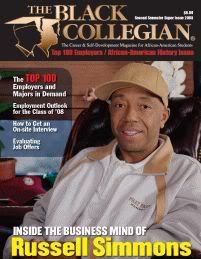 Inside the Business Mind of Russell Simmons
You're a Graduate and No Job... Now What?
Protect Your Credit Rating
Top 100 Employers for Class of '08
How to Get an On-Site Interview
Handling the Rejection Letter
Inside the Business Mind of Russell Simmons
You're a Graduate and No Job... Now What?
Protect Your Credit Rating
Top 100 Employers for Class of '08
How to Get an On-Site Interview
Handling the Rejection Letter