Power Walking to the Polls in November
By Lorenzo Morris, Ph.D.
For today’s college students the pay-off or pay-back of the coming election is deceptively closer than it appears because a kaleidoscopic environment of political uncertainties may be resolved for better or worse by 2012. Four years from now today’s freshmen will face a largely changed political environment marked by a restrictive political alternatives and shrinking economic options in which the role of government and our responsibility for it will be more critical. Whatever happens in the elections, some choices are certain to be just around the corner but the viability of our options depends heavily on what we do in November.
In addition to death and taxes, there seems to be one certainty ahead of today’s collegians. Namely, they will use a lot more of their own foot power and/or public transportation than their predecessors because oil will be more scarce, prices more prohibitive and the magic promise of alternative energy sources still unrealized. Since they will be doing more walking, it is worth considering where they will able to walk, under what new conditions and what public policy directions are likely to their transition into the “real” world.
In four years African-American students who are going to graduate or professional schools, as well as most of them entering the workforce can largely forget about affirmative action options in anything like the past ones. Hopefully some diversity sensitive variant will survive but creative legislative and administrative initiatives will be required. The next president cannot simply abide by existing regulations because they are falling apart. Eight years from now, if nothing changes, the decline in Black male college enrollment will have reached destructive proportions and negative effects on employment would be sure to follow.
Along with higher education choices, choices for Supreme Court nominations cannot wait four more years. The nation is almost literally one aging justice away from upsetting a whole panorama of civil rights and liberties law. Whether walking near home (as the recent gun-control Supreme Court ruling brings to mind) or driving while Black, our vulnerability to violence lurks in the future of a mismanaged judiciary. With every year out of school, the sense of immorality among the young will fade into the realism of which our Court’s fragility reminds us.
Whether they walk or ride to the voting booth, students should recognize that voting rights guarantees written in the 1960s may be subject to the kind of fine print manipulation inattentive people so often face. If they replace the voting booth with the absentee ballot, the need for careful regulation may be even more critical. Already conservative backed litigation capable of disabling the Voting Rights Act is making its way through the courts (Austin M.U. D. v. Mukasey, 2008). Any responsible administration would work to protect VRA but it would succeed only if Congress members know their reelection futures are on the line.
If students decide to pound the pavement in search of a job, the market is likely to have changed substantially by 2012. While elected officials can affect public sector employment and job availability in highly regulated industries, globalization, trade and energy policy are likely to be most sensitive to the president’s touch. How far new employees will have to walk or ride to work, whether globalization or NAFTA will put entry level jobs farther out reach will reflect the voters’ choices made this year.
If graduates chose to transform their walking into a military cadence, then the choice in November promises to rearrange the map of their future. Whether they march to the drumbeat of war of intervention or step to different drummer may depend on the vote. American involvement in Iraq four years ago shows how much voter resolve could have influenced our international situation today and how little the past lack of voter resolve has brought us.
If students seek to escape the grungy world of politics for the even more grungy but fantasy-laden land of YouTube, they may only add to their disillusionment. For example, a recent posting from a movie about a gang “warrior,” projected as political leader, suggests that attempts to negotiate conflicts or end partisan bickering are doomed to violent failure. The ultimate effect is to make the observer feel completely powerless. Perhaps, that is the subliminal message of much of video political culture. Vegetating in front of the computer screen can never match the healthy effects of a walk to the polls, although a pause to check out the websites of the major parties and third parties is worth the time.
If the stress of watching conflict, too much walking or too much partying ends making healthcare an issue for the graduate, then they will find themselves confronting the shrinking options public vs. private healthcare. Here the trip to the polls may be most critical because the choices are stark and largely inescapable. National healthcare will undergo big changes in fours years but the big decision comes in four months.
The good thing about walking is not just that it can take you where you want to go but that the process itself can transform the body and invigorate the mind. Much the same can be said of voting and election results. If the destination disappoints, the walk there still rewards the effort. W.E.B. DuBois made a similar point about voting a century ago when he responded to questions about what blacks could expect from voting in a segregated society. He effectively argued that voting is the simplest, basic act of self empowerment and affirmation of political consciousness. Perhaps, one of the myths of voting is that it is a secret process. The ballot is secret but the attitude, the political awareness and the sense of purpose that voters show is not. Like confidence, it shows. Whatever the election result, the longest road to power begins with this first crucial step, the vote.
Lorenzo Morris is professor and chair of the Howard University Political Science Department. Previously, he was Assistant Professor at the Massachusetts Institute of Technology and a Brookings Institution Research Fellow. He has published five books and about one hundred articles on diverse subjects including electoral politics, black politics, comparative politics, community development and higher education policy. He has been a consultant on election organizing, education policy and party politics in several countries, particularly in Africa. He is currently doing research on racial minorities in party politics in the U.S. and France. He received his Ph.D. degree from the University of Chicago and B.A. from Fisk University.
 Posted By: Jon C.
Thursday, July 24th 2008 at 10:10AM
You can also
click
here to view all posts by this author...


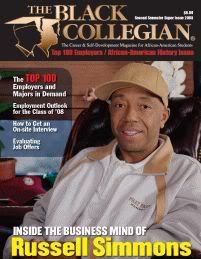 Inside the Business Mind of Russell Simmons
You're a Graduate and No Job... Now What?
Protect Your Credit Rating
Top 100 Employers for Class of '08
How to Get an On-Site Interview
Handling the Rejection Letter
Inside the Business Mind of Russell Simmons
You're a Graduate and No Job... Now What?
Protect Your Credit Rating
Top 100 Employers for Class of '08
How to Get an On-Site Interview
Handling the Rejection Letter